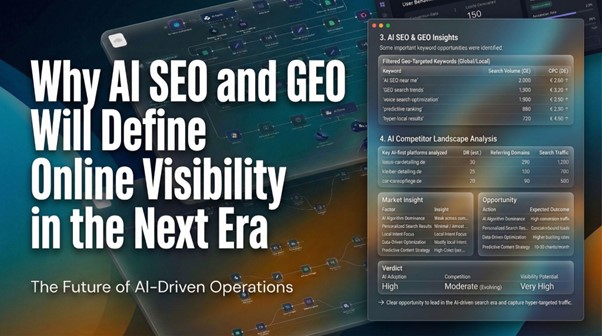
For years, visibility online was controlled by a relatively simple dynamic. Businesses optimized their websites for search engines, ranked on results pages, and competed for clicks.
That model is breaking.
Search is no longer limited to traditional engines. Users are now asking questions directly to AI systems, receiving synthesized answers instead of lists of links. At the same time, platforms are becoming more context-aware, delivering results based not only on keywords, but on intent, behavior, and location.
This shift introduces a new reality: visibility is no longer about ranking alone. It is about being selected, understood, and surfaced by intelligent systems.
This is where AI SEO and GEO begin.
Traditional SEO was built around optimizing for algorithms that ranked pages. It focused on keywords, backlinks, technical structure, and content formatting.
AI SEO operates differently.
Instead of optimizing only for ranking positions, businesses must now optimize for interpretation and inclusion within AI-generated responses. When a user asks a question, AI systems analyze vast amounts of content and produce a direct answer.
The goal is no longer just to appear on page one, but to be part of the answer itself.
This changes how content is created. It must be clear, structured, authoritative, and context-rich. AI systems prioritize information that is easy to understand, well-organized, and credible.
Weak, generic, or purely keyword-driven content becomes invisible in this environment.
In other words, AI SEO rewards clarity and depth over manipulation.
Geographic optimization, or GEO, is not new—but it is becoming far more sophisticated.
Previously, local SEO focused on optimizing for phrases like “near me” or city-based keywords. Today, AI systems incorporate real-time context, user behavior, and environmental data to deliver highly specific results.
This means businesses are no longer competing only within static keyword categories. They are competing within dynamic, context-driven queries.
For example, a user may not search “best clinic Vienna,” but instead ask an AI system:
“Where should I go for a high-quality diagnostic center near me with fast availability?”
The system will not simply pull a list of websites. It will evaluate:
And then provide a direct recommendation.
GEO, in this sense, becomes about ensuring your business is understood and prioritized within these contextual decisions.
One of the most important changes is the movement from rankings to recommendations.
In traditional search, users compare multiple options. In AI-driven environments, the system often presents a limited set of answers—or even a single one.
This compresses competition.
Instead of competing for attention among ten blue links, businesses compete to be included in a small number of AI-selected outputs. The difference between being included and excluded is no longer marginal—it is absolute.
This creates a winner-takes-most dynamic, where visibility is concentrated among businesses that are best optimized for AI interpretation.
The way content is written and organized is becoming critical.
AI systems favor content that:
This means businesses must move away from surface-level blog posts and toward information architecture. Content should be designed as a network of insights, not isolated pages.
Well-structured content increases the likelihood that AI systems will extract, reference, and present it in responses. Poorly structured content, even if informative, is often ignored because it is harder to process.
Authority used to be signaled primarily through backlinks and domain strength. While these still matter, AI systems are expanding how they evaluate credibility.
They analyze:
Authority is no longer just about who links to you. It is about how well your knowledge holds up when interpreted by machines.
Businesses that invest in high-quality, consistent, and deeply informative content will have a significant advantage in this new environment.
Despite how quickly this shift is happening, most businesses are still operating under outdated assumptions. They focus on keyword density, minor technical optimizations, or short-term ranking tactics.
These approaches are becoming less effective.
The real challenge is that AI SEO and GEO require a different mindset. It is not about gaming the system, but about aligning with how intelligent systems process and prioritize information.
This requires:
Most businesses are not structured for this yet, which creates a temporary window of opportunity for those who are.
As with any major shift, early adopters gain disproportionate benefits.
Businesses that optimize for AI-driven discovery now can:
Late adopters, on the other hand, will find themselves competing in a space where visibility is already consolidated.
By the time AI SEO becomes widely understood, the top positions—both in rankings and in AI-generated answers—will already be occupied.
The concept of search is evolving into something broader and more complex. It is no longer just about engines indexing pages, but about systems understanding and delivering information in real time.
AI SEO and GEO represent the next phase of this evolution.
Businesses that adapt will not just rank higher—they will become the sources that AI systems rely on. Those that do not will gradually lose visibility, regardless of how well they performed under previous models.
The shift is already underway. The question is not whether it will happen, but who will position themselves early enough to benefit from it.